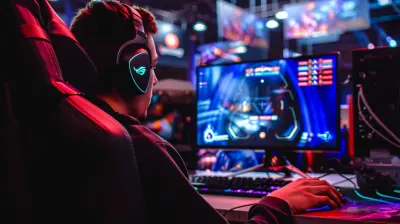
Exploring the Role of AI in Modern Consoles
5 May 2026
If you’ve been keeping an eye on the video game scene lately, you’ve probably heard a lot of buzzwords flying around—ray tracing, haptic feedback, cloud gaming... and of course, AI. But what does artificial intelligence really mean in the world of gaming? And more importantly, how is it shaping the consoles we love so much?
Well, buckle up. Because we’re diving deep into how AI isn’t just part of the future of gaming—it’s already woven into your next-gen console experience. Whether it’s smarter NPCs, adaptive difficulty, or real-time enhancements, AI is doing more than just playing catch-up—it’s setting the pace.
What Do We Mean by AI in Gaming?
Let’s break it down. When we say AI in gaming, we’re not necessarily talking about sentient robots planning world domination. We’re talking about systems and algorithms that make in-game experiences more dynamic, responsive, and realistic.Think of AI as the game’s brain. It decides how enemies react to your moves, how characters speak to you, and even how the game world behaves. The smarter the brain, the better and more immersive your gaming experience gets.
But now, thanks to modern consoles like the PS5, Xbox Series X, and even cloud-based systems like NVIDIA GeForce Now, AI is punching way above its weight. It’s not just a background player anymore—it’s front and center.
Smarter NPCs: Enemies That Actually Outsmart You
Ever feel like enemies in older games had the intelligence of a brick? Yeah, us too. They’d just run straight at you, no real tactics, just cannon fodder. But not anymore.AI-driven NPC (non-player character) behavior has come a long way. In modern games, enemies flank you, use cover, and even retreat when they’re outmatched. Games like The Last of Us Part II or Ghost of Tsushima showcase AI that adapts in real-time, reacting to your decisions and changing tactics on the fly.
This isn’t just about making things harder. It’s about making them more believable. When AI behaves like a real opponent instead of a script-following bot, every encounter feels fresh—and challenging.
Adaptive Difficulty: Games That Understand YOU
Ever rage-quit a game because it was way too hard—or got bored because it was too easy? Game devs get it. That’s why many modern titles are using adaptive difficulty powered by AI.Here’s how it works: the game watches how you play. If you’re breezing through levels like a pro, it might throw in tougher enemies or fewer checkpoints. Struggling? It might slow things down a bit. The idea is to keep you in the “flow zone”—not too easy, not too frustrating.
Games like Resident Evil 4 Remake and Left 4 Dead already use this technique masterfully. It’s invisible but powerful. You might not notice it happening—but your mood certainly will.
Procedural Generation Gets a Brain Boost
Randomly generated worlds have been a thing for a while—just ask any Minecraft player. But now, AI is taking procedural generation to a whole new level.AI algorithms can craft entire worlds, story arcs, or dungeon layouts that are cohesive, balanced, and fun. Instead of random blobs of terrain or out-of-place story moments, you get content that feels hand-crafted—even if no human touched it.
Roguelikes like Hades and Returnal use this smart content generation to keep the game fresh every time you play. AI ensures things make sense, telling beautifully chaotic stories one level at a time.
AI-Powered Graphics Upscaling and Frame Optimization
Let’s talk tech for a sec. One of the biggest breakthroughs in AI recently has been graphical enhancement—especially upscaling.NVIDIA’s DLSS (Deep Learning Super Sampling) is a good example. It uses AI to render frames at a lower resolution and then scales them up without sacrificing visuals. You get buttery-smooth framerates and sharp visuals. Not a bad deal, right?
And it’s not just on PC. Console equivalents—like AMD’s FidelityFX Super Resolution—are making their way into the next-gen consoles too. The AI isn’t just brain-smart—it’s eye-candy-smart, giving us more with less horsepower.
Voice Recognition and AI Assistants: Talking to Your Console
Ever wished your console could just listen to you? Guess what—it kinda can.Voice recognition has been creeping into gaming for years, but modern consoles (and cloud platforms) are leveraging it like never before. Google Stadia, for all its ups and downs, toyed with AI assistants that could give you real-time help.
Imagine getting stuck on a puzzle and just saying, “Hey console, how do I beat this boss?” and getting instant, context-aware advice. No pausing, no Googling. Just straight-up help. That’s the dream, and AI’s making it possible.
Personalized Gaming Experiences
This one’s huge. AI can learn your preferences—what types of weapons you use, how much time you spend exploring, even whether you lean toward stealth or chaos.Armed with this data, games can tailor experiences to match your playstyle. Maybe it recommends a stealth loadout before a mission, knowing that’s your usual vibe. Or perhaps it picks tougher dialogue options because you love extra challenge.
This kind of personalization makes games feel more like your story. It’s like having a dungeon master who knows exactly how to keep you hooked.
AI in Game Development: Speeding Up the Creative Process
AI isn’t just helping gamers—it’s freeing up game developers, too.By automating time-consuming tasks like animation, dialogue generation, and testing, AI speeds up the development process. Studios can focus more on creativity and less on grunt work.
Tools like Unity’s ML-Agents and AI-driven QA testing allow devs to simulate scenarios hundreds of times faster than manual playtesting. That means fewer bugs, faster timelines, and more polished games.
And yes, that also means there’s more room for innovation. When AI handles the boring bits, humans can dream bigger.
Cloud Gaming and AI Streaming Optimization
The future of gaming might not live on a disc or even your hard drive—it’s living in the cloud.AI plays a massive role in cloud gaming by managing server loads, optimizing streaming quality, and reducing latency. Platforms like Xbox Cloud Gaming and NVIDIA GeForce Now are using AI to predict where bottlenecks might happen and fix them before you even notice.
Imagine never needing to download huge patches or worry about compatibility. With AI behind the scenes, cloud gaming could soon offer a plug-and-play experience that rivals, or even exceeds, local hardware.
Ethical Concerns and the Future of AI in Consoles
Alright, not everything about AI is all sunshine and speed boosts. With great power comes... well, great responsibility. And there are some real concerns we need to talk about.For starters, there’s data privacy. If AI systems are learning from how you play, what else are they learning? Are they storing voice data? Are they tracking too much?
Then there’s the risk of AI replacing jobs in game dev, or creating homogeneous game experiences if not carefully balanced. AI should be a tool for making games better, not just faster.
It’s a fine line—but one that the industry is paying attention to. As players, it’s on us to stay informed and vocal about how our data and experiences are handled.
Looking Ahead: Where Is This All Going?
So what’s next? Honestly, the sky’s the limit.We’re talking about AI systems that can write questlines in real time. Game worlds that change based on your emotional state (yes, emotion detection is a thing). Even AI companions that learn about you over dozens of hours of gameplay and evolve as characters.
It’s no longer science fiction. Developers are already experimenting with these ideas, laying the groundwork for the next big leap in gaming.
Modern consoles are built with AI in mind—from their processors to their cloud connectivity. So expect the AI features we’ve talked about to keep growing, evolving, and surprising us.
Final Thoughts
AI in gaming is no longer just fancy gimmickry—it’s become a cornerstone of modern game design and hardware. From smarter enemies to personalized game worlds, AI is transforming how we play, what we expect, and how games are even made.So the next time your console loads a massive open world without a hitch, or an NPC calls you out for that sneaky backstab, just remember—there’s a whole lotta AI magic happening under the hood.
And trust me, we’re only just getting started.
all images in this post were generated using AI tools
Category:
Game ConsolesAuthor:

Kaitlyn Pace
Discussion
rate this article
2 comments
Maisie Monroe
The integration of AI in modern consoles has transformed gaming. It enhances player experiences through personalized content, smarter NPC behavior, and improved graphics. This evolution not only elevates gameplay but also sets new standards for development, pushing creative boundaries in the industry.
May 31, 2026 at 3:07 AM
Kaitlyn Pace
Absolutely, the role of AI in gaming is a game changer. It's fascinating to see how it personalizes experiences and pushes creative limits. Exciting times for the industry!
Trevor Roberts
This article highlights how AI enhances gaming experiences on modern consoles. From smarter NPCs to personalized content, the impact is significant. Excited to see where AI technology takes gaming in the future!
May 8, 2026 at 3:55 AM
Kaitlyn Pace
Thanks for your thoughts! I'm excited too. The potential of AI in gaming really is incredible... let's see how it evolves!